You’re Resilient. That’s not the same as Mentally Fit.
The project demands substantial effort, and the client is restless. Despite a perpetually demanding schedule, you reliably deliver on time, but the impact accumulates quietly beneath the surface. Last week, I introduced performative resilience—an indication you're operating via autopilot. It’s a condition where unconscious routines direct your actions unchallenged. You display confidence, expertise, and composure—even while fatigued. You perform, earn recognition, appease the client, yet your intuition signals that none of it feels genuine. For high performers, autopilot rarely appears problematic; it feels essential to the role.
Autopilot means your thoughts, emotions, and actions unconsciously drive your stress, decisions, and performance. This makes autopilot hard to notice. Early mornings and late nights become habitual, and sometimes no time management approach can ease the relentless demands. So, you persist, showing resilience, the outcome of enduring adversity. This isn't just a mindset issue. As Dr. Gareth Craze writes in his January 2026 Forbes article, Why Mental Fitness Is Leadership's Next Frontier, "every act of judgment, attention, and self-control has an underlying physiological component and cost." Chronic depletion quietly widens your error margins before you ever notice it. The solution to close the gap starts with mental fitness.
About Mental Fitness
Mental fitness involves shifting away from autopilot and accessing conscious awareness to choose a mindset that benefits you. Mental fitness doesn't remove the demanding client, compress the schedule, or lessen the workload. The external pressures remain unchanged. What alters is your internal relationship to those factors—you cease simply reacting. You gain a moment of clarity. You identify the pressure, label it, and choose a response rather than absorb it. It's not self-care or a fleeting wellness fad. It’s the practiced ability to recognize when you’ve lost conscious awareness—when you’re on autopilot or reacting automatically—and to reclaim control.
Unlike mental health, which is focused on avoiding psychological harm or impairment that would block your job, mental fitness is a threshold you meet or don’t. It's about how strongly your mind functions under strain, over time, and under pressure. Mental fitness means recognizing when your mind defaults to self-sabotaging patterns that cause suffering rather than deliberate actions, and distinguishing between them so you act with intention. It’s about regaining control and composure. This skill shifts mere survival in challenging client conversations to genuine leadership.
As Craze puts it, "Mental health is the floor. Mental fitness is an advantage.”
For consultants, it’s the difference between going through the motions and truly leading the room.
The Shift AI is Forcing
As AI automates routine tasks, what remains demands judgment, presence, and adaptability. Developing these qualities begins with self-awareness and an assessment of your mental state (Presence), building the ability to silence distractions (Capacity), making decisions grounded in clarity (Conscious Choice), and sustaining momentum (Momentum). This process starts with mental fitness.
The Two Mental Modes Running Your Stress, Decision, and Performance
In high-stakes client meetings, you may notice two internal states. One compels you to over-explain, attempt control, and second-guess—resulting in missed opportunities and unclear communication. The other promotes clarity, composure, and concentration, enabling you to ask timely questions and direct the discussion. This is not random variation—it reflects two distinct mental modes. The first, the Saboteur, functions as your inner critic: habits and drives that previously supported achievement now operate unchecked, undermining performance. The second, the Sage, represents optimal clarity—calm, focused, and adaptive, even under pressure. When the Saboteur is unchecked, the Sage is diminished.
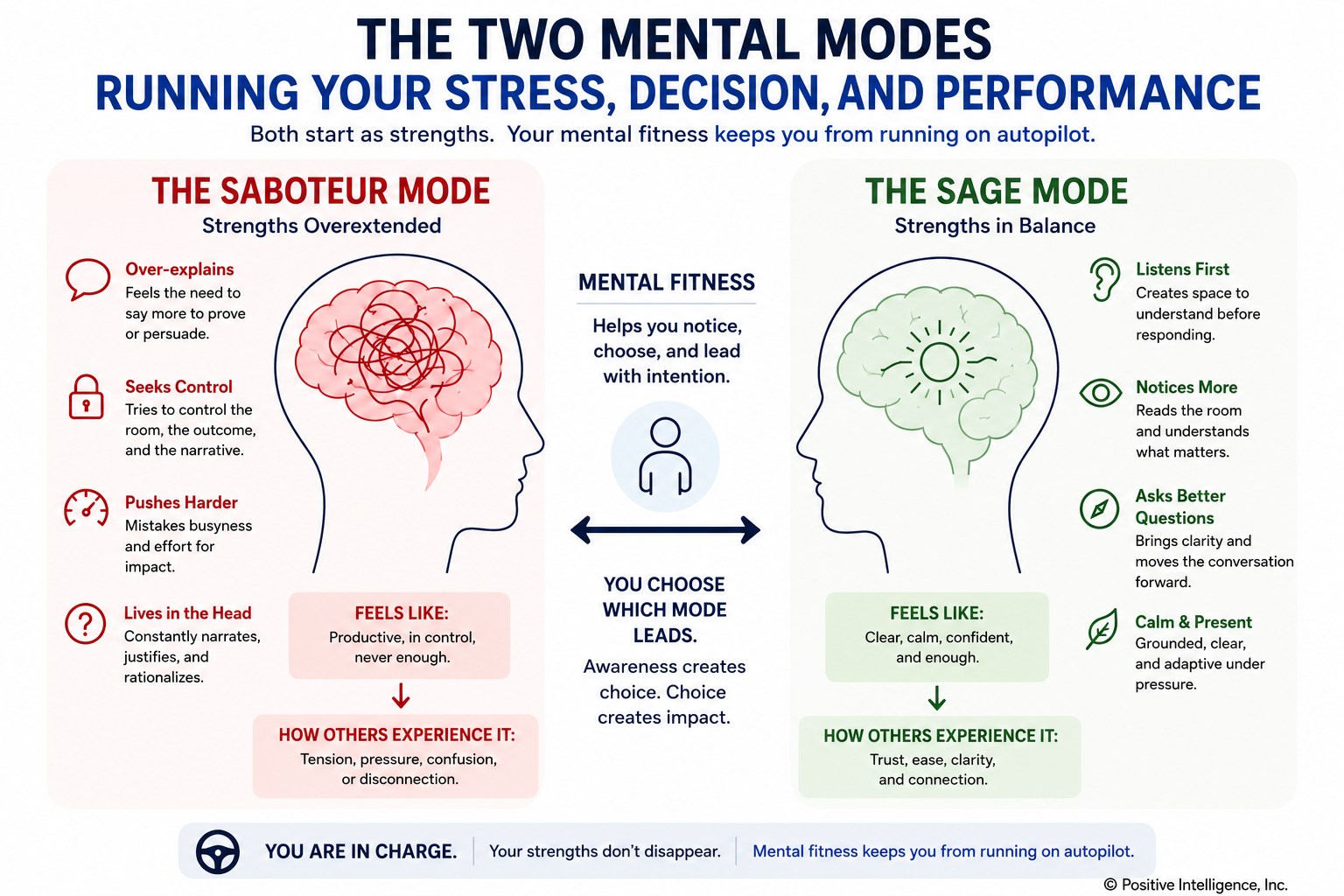
Example of the PQ Framework
By using Sherzad Chamine's Positive Intelligence (Saboteur vs. Sage) framework, you can spot which patterns appear in critical moments—and choose how to respond. Recognizing the driver is the first step to shifting toward your best self. Mental fitness brings clarity and analytical precision. Actions shift from effortful to effortless, empowering you to determine which mode directs laser-focused action, free of Saboteur interference.
How You Can Leverage The Self-Mastery Strengths of the Sage
In Part 3 next week, I'll get specific about what changes when you can access your Sage under pressure — how you show up in the room, how you make decisions, and what it feels like to lead from clarity rather than autopilot.
Curious about which Saboteurs are steering your autopilot? Request the five-minute assessment to get a clear picture of the patterns holding you back, and start charting a new course.